
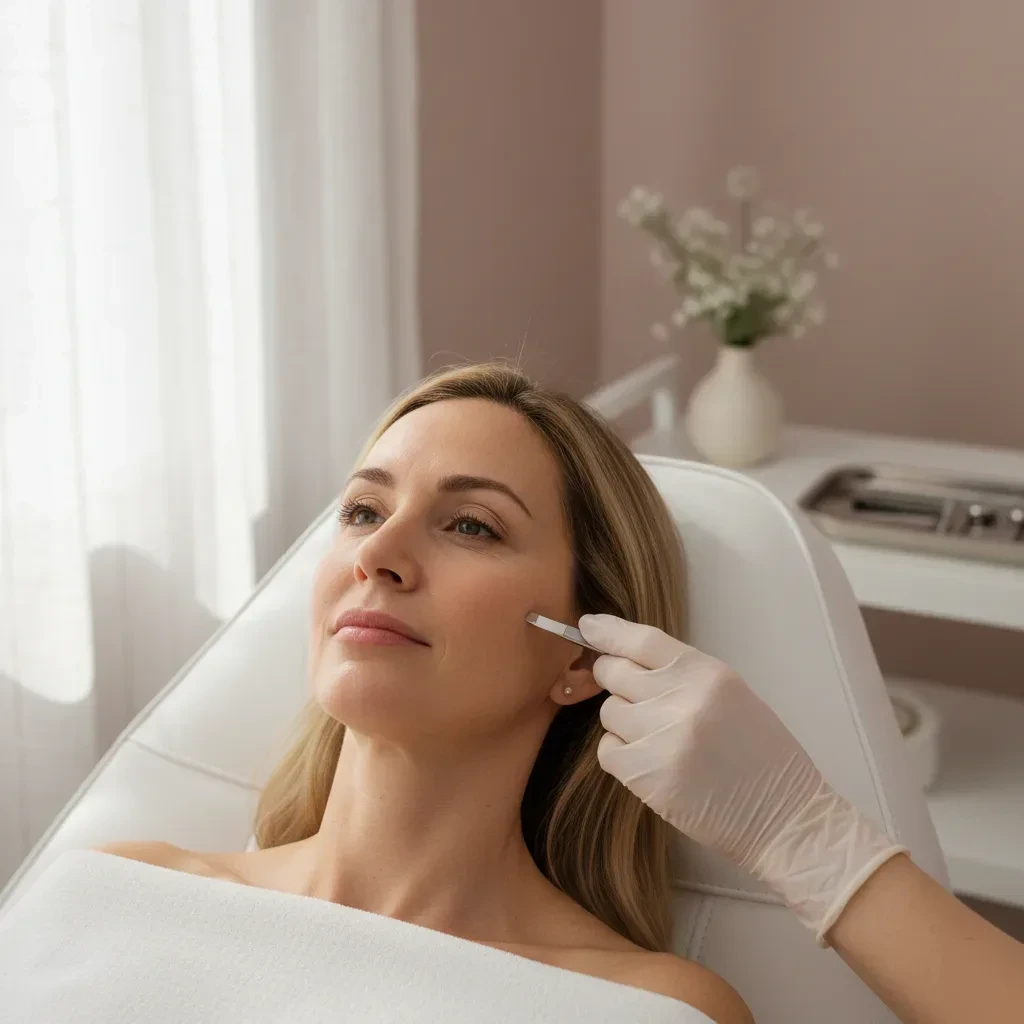
What's Covered on This Page
- Understanding Dermaplaning's Benefits
- Certain Skin Types and Concerns for which Dermaplaning is Particularly Helpful
- What Happens During Your Dermaplaning Session
- Post-Treatment Recommendations for an Outdoor and Coastal Lifestyle
- How Often Should You Schedule Dermaplaning for Long Lasting Results?
- Does dermaplaning work well for people who spend a lot of time outdoors near Murrells Inlet?
- Will the peach fuzz grow back thicker or darker after dermaplaning?
- Is dermaplaning safe if I have sensitive skin or can't tolerate chemical peels?
- How long does a dermaplaning appointment take and is there any downtime?
- How often should I get dermaplaning done?
- Can I wear makeup or use my regular skincare products right after dermaplaning?
Understanding Dermaplaning's Benefits
Folks come into our office thinking that dermaplaning is literally just shaving their face. It isn't.
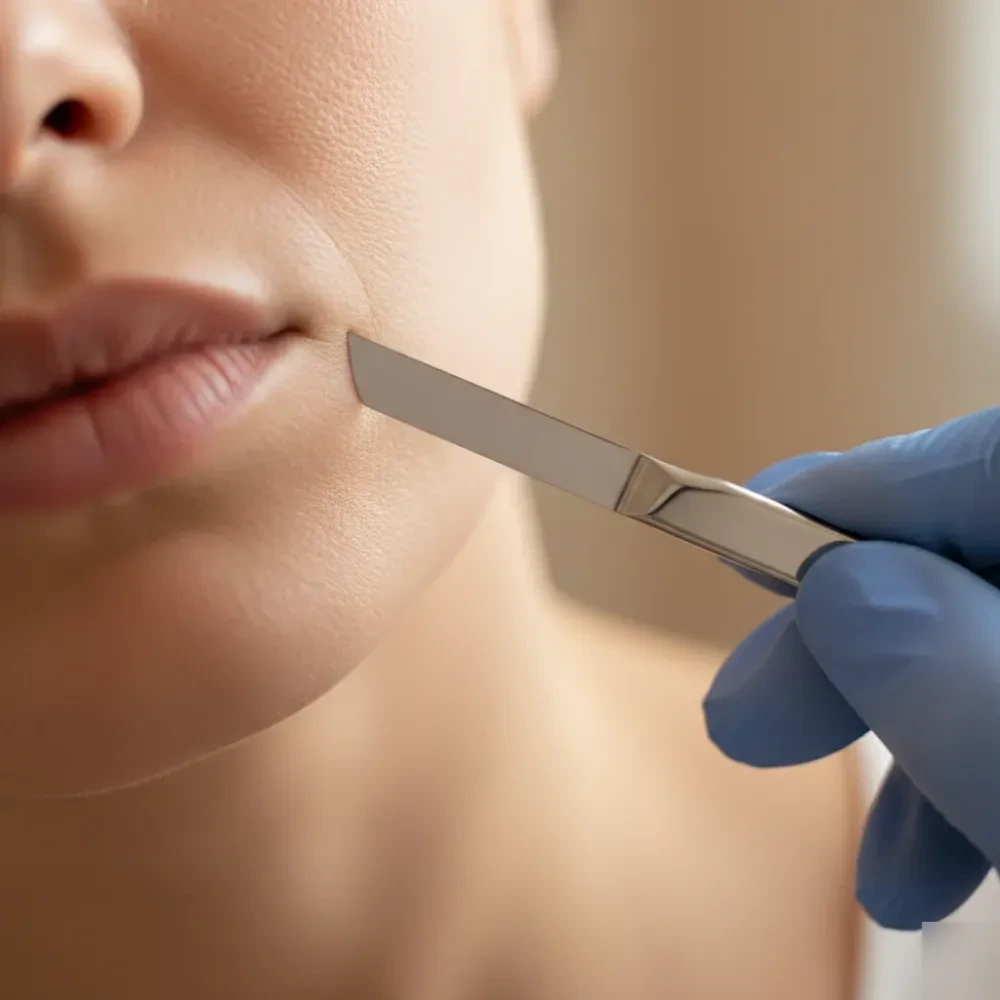
A sterile surgical blade is being gently glided across the face on an angle to remove the topmost layer of dead skin cells, as well as vellus hair or peach fuzz that catches in our eyes while we look in our cars or ring light photos. However, more important than that is what happens next. As the dead layer of the skin is removed, skin begins to breathe more freely and products begin to absorb faster, while makeup applies smoother to skin without clumping.
You can expect a visible result after your first treatment. This is because dermaplaning stimulates natural exfoliation, which encourages rapid cell turnover and renewal in that the process removes approximately 2-3 weeks of accumulated dead skin cells. The American Academy of Dermatology says that this process can improve skin texture and tone in the short term as well as in the long term. You have a more radiant complexion immediately because of the fresh layer of skin that is revealed.
Our clients tell us their skin feels and looks different because of dermaplaning:
- Softer and smoother skin right after the session
- Easier foundation and serum application the following day
- A glow that you will see that lasts anywhere from 1-2 weeks
- A softening of fine lines and wrinkles around the mouth and brow area
People tell us that it is what they need because they want better skin, especially those who live near the Inlet Square area.
And something that people might find surprising is that the peach fuzz doesn't grow back coarser or darker. That is a misconception that continues to be believed. Vellus hair is vellus hair. It grows back just as it had left.
We have to reassure many first-time clients about that.
Dermaplaning can be used as a standalone treatment or used in conjunction with other services we offer, such as chemical peels or medical grade facials. Dermaplaning allows active ingredients to penetrate to greater depths as there is no barrier between the surface of the skin.
Dermaplaning is just one part of everything our Murrells Inlet medical spa offers.
Certain Skin Types and Concerns for which Dermaplaning is Particularly Helpful
Dermaplaning is appropriate for most if not all skin types. This is something that I constantly hear when I talk to my clients here in Murrells Inlet, because there is a common misnomer that one type of skin will only respond favorably to the treatment.
This is not the case.
Dermaplaning is an ideal treatment for people whose skin is dull, dry and flaky. If the face looks lifeless, this is most likely caused by a buildup of dead skin cells. This is common for our customers who have lived with exposure to salt water and sun for an extended period of time. Dermaplaning removes this buildup and reveals fresh, new skin that looks and feels more radiant within just 24 hours.
These are the skin types and conditions that we most frequently see dramatic improvement with:
- Fine lines and a rough, uneven surface caused by either sun damage or the natural aging process
- Peach fuzz accumulation which collects debris and prevents foundation from applying smoothly
- Dullness or flakiness in areas that remain stubborn despite attempts at mechanical scrubs or household exfoliants
- Patchy skin tone or superficial dark spots/hyperpigmentation
- Delicate skin that struggles to tolerate liquid or chemical exfoliators
This last category is often what catches folks off guard. We regularly work with clients that have experimented with acids or peels and found their skin becomes inflamed as opposed to clarified. With dermaplaning we offer the benefits of exfoliation they are looking for, but without the chemical irritation. Because it is a manual treatment, it is gentle and free from any potential burning or stinging sensations.
Now of course there are a handful of exceptions. For instance we would not want to proceed with a client that has active cystic breakouts. If you have inflamed lesions that are raised or sensitive to the touch we wouldn't treat. Similarly if we notice signs of active cold sores or an open wound we would skip dermaplaning.
However, we have found that acne scars are actually helped with regular dermaplaning, smoothing them out over time.
That being said, most of our clients are excellent candidates for our treatments. Before every appointment, we assess your skin to you are ready for your session. If something appears abnormal or we deem dermaplaning inappropriate at the time, we inform our guest right away. Dermaplaning has been shown by the American Academy of Dermatology to be a safe exfoliating method for most skin types and we adhere to these guidelines daily.
Not sure whether your skin will benefit from dermaplaning? Give us a call and we would love to speak with you.
What Happens During Your Dermaplaning Session
Guest walk in. We chat. Dermaplaning begins.
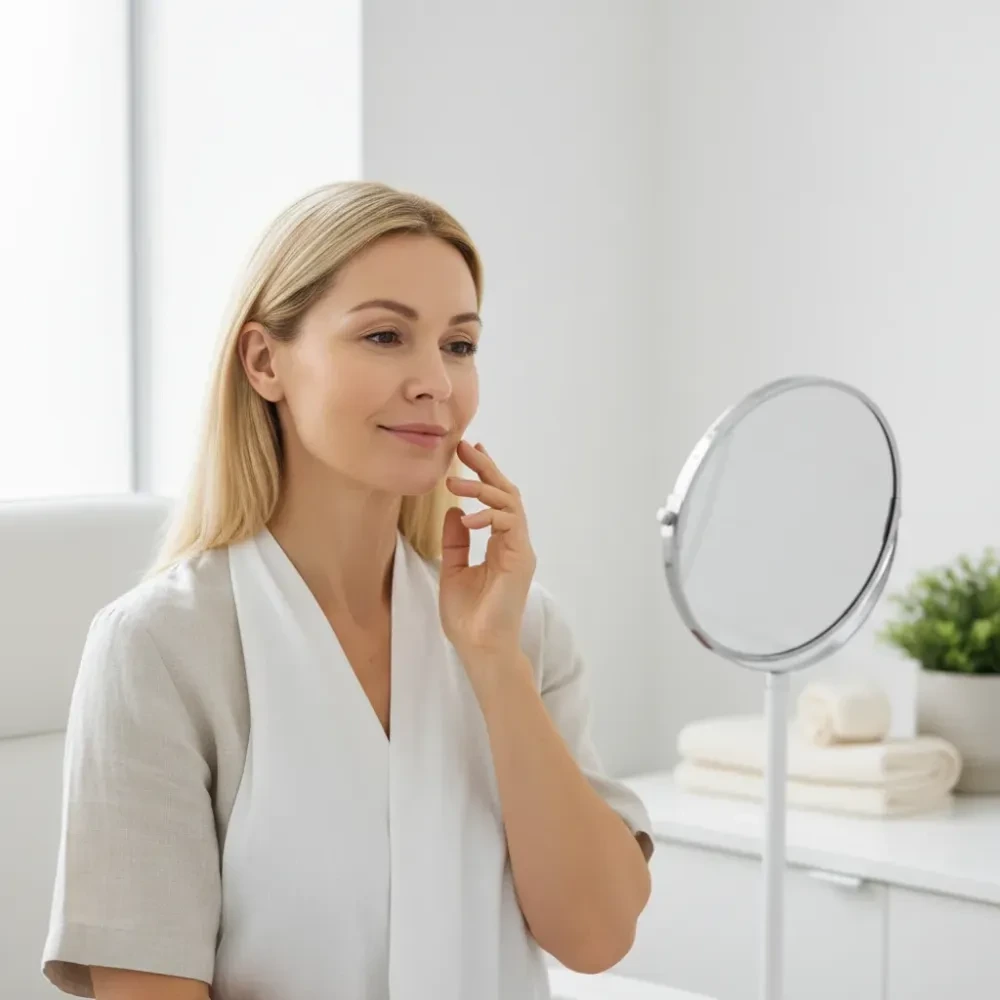
With every single person, we take a few minutes before we even touch a scalpel to learn about your skin. We look for active pimples, signs of heightened sensitivity or any additional areas we will need to work on extra carefully. If you are wondering how exactly dermaplaning works, let's go through each step, beginning with your visit here in Murrells Inlet.
- We wash your skin and remove any makeup or SPF you are wearing.
- Before any blades make contact with your face, we lightly mist your skin with an astringent so the scalpel will slide easily across your face.
- Using a scalpel held at a particular angle, the blade will scrape the top layer of skin in short strokes.
- We will cover the majority of your face – including forehead, cheeks, chin, and jawline – taking sections as we work.
- We will apply a soothing treatment oil along with sun protection before sending you off.
The entire process can be as fast as 30 to 40 minutes. Many of our guests remark that it feels like a credit card being run lightly over the face. There is virtually no discomfort and most often some guests even snooze on the chair.
Every single day at least once, we have someone come in terrified and tightening their arms around the headrest. By the 10 minute mark, our clients are relaxed and asking why they ever waited so long. Another one that people really don't anticipate is the immediate change in their complexion. It's noticeable right away upon viewing the mirror.
The haze is gone, the peach fuzz is gone, the light bounces off the face in new ways. Also, any products that are applied after the treatment (such as that evening), will actually absorb into the skin. Your creams, serums, and moisturizers won't be going through a layer of dead cells, they'll go onto the skin where they belong. It is a procedure with absolutely zero recovery time.
It is a procedure where a client stops by after lunch and returns back to work afterward. A little bit of flush is normal for an hour or so and it goes away quickly. It is a no peeling, no scabbing, no staying home a few days procedure. We have our licensed estheticians look at each individual's skin prior to treatment.
If we determine that dermaplaning is not a good fit for a person on any given day we'll advise them of that as well.
Need help with dermaplaning?
Book An Appointment. Jolie Visage Rejuvenation Centre is ready to help.
Post-Treatment Recommendations for an Outdoor and Coastal Lifestyle
Your life is going to impact how we tell you to manage your treatment. That is because of where we live. Here in our beautiful coastal location we have a client pool and lifestyle that is unique to us. Your complexion will be newly exposed.
There is no dead cells anymore to form a barrier between your skin and the outside world. There is no peach fuzz acting as a second layer of filter anymore, as well. That means your skin will be reacting to sun, salt, and humidity differently than you are used to over the next few days. People seem to really enjoy their newly glowing, ultra-soft skin, they just need an easy plan to help them keep it that way.
So, this is what we share with every single client before they are leaving our office:
- Apply an SPF 30 or higher broad-spectrum sunscreen before going outdoors. If you spend the day on the water or the MarshWalk you need to remember to reapply every 2 hours.
- Wait 24 hours to apply makeup. Let the skin absorb the skin products that we will recommend without having makeup in the way.
- Try to avoid direct sun for a couple of days if possible. If you are unable to stay inside, wearing a hat with a larger brim is a must.
- Use an extremely gentle and non-scented cleanser the first three days. There should be no acids or exfoliating granules.
- Keep yourself well hydrated. Apply moisturizer every morning and night. Your skin will be very receptive to hydration.
- If you will be in any saltwater (beach, kayak, anything), we suggest rinsing off with fresh water as soon as possible after that activity. The salt pulls out moisture from skin. It is the most common form of irritation we see during the summertime. Same with chlorine from pools.
That said, one really cool part about this treatment is that most skincare products work that much better once the facial hair and dead skin cells are gone. You can really start to notice a difference in skin products. Clients report staying soft for weeks just by doing these few basic steps. Success in your skincare does not need a complex approach; it requires consistency with sunscreen and moisture.
Can't decide which product you should use for your skin type? Give us a call. We will let you know. Keep your skin safe from the sun, clean and hydrated and that is really all you need to do.
Your skin takes care of the rest.
How Often Should You Schedule Dermaplaning for Long Lasting Results?
After your first session, we will hear people say that they can't wait to book their next dermaplaning appointment next week. We get that! Your skin feels amazing. However, your skin must be done with a cycle of growth and regrowth before a second round of dermaplaning will work.
On average, that cycle for adults takes place over a period of 3-4 weeks. Scheduling your follow up too soon will not give you the best results, but will irritate skin that is still repairing itself. For our clients living in Murrells Inlet, we recommend every 4-6 weeks. This frequency is ideal to keep skin smooth and the effects lasting between appointments.

What Will Impact Your Timing?
The schedule mentioned above isn't one-size-fits-all. There are a few factors that might move your appointments around:
- Skin type and speed of hair regrowth
- Sun exposure when out on the water or near the MarshWalk
- Combination of dermaplaning and other services (ex. chemical peels, medical grade facials)
- Seasonality and increased oil production or dead skin buildup
Someone who struggles with oilier skin and has an accelerated growth rate, might find themselves scheduling appointments closer to 3 week intervals. On the other hand, someone with dryer skin may do great every 5-6 weeks. Everyone is different and we assess how your skin is reacting to plan accordingly.
Typically a regular rhythm will begin to take shape by the 2nd or 3rd appointment. Most clients will know what they need to do in regards to treatment timing by this point.
Having that consistency is key. We find that by sticking with a regular appointment plan, your clients aren't allowed time to become overworked with dead skin cell buildup between visits. You'll see that your serum products work better and foundation goes on better. And you'll notice your complexion stay radiant instead of just for a few short weeks.
It is similar to mowing your lawn; if your yard gets overgrown and no longer looks great you will need to cut back more heavily than just simply maintenance.
We also love to have our clients schedule a vitamin C facial or enzyme facial every other dermaplaning appointment. They will enjoy an even longer-lasting set of results as the services stack over the month or months ahead. And if you don't know the appropriate dermaplaning frequency, that is okay! ! Just ask, and we can help you determine the best schedule for your skin.
Frequently Asked Questions
Common questions about dermaplaning services in Murrells Inlet
Does dermaplaning work well for people who spend a lot of time outdoors near Murrells Inlet?
Yes, dermaplaning is a great fit for the coastal lifestyle here in Murrells Inlet. Salt air, humidity, and sun exposure speed up dead cell buildup on your skin. Dermaplaning clears that layer fast and gives your skin a fresh start. After your appointment, you'll want to wear SPF every day and avoid direct sun for at least 24 hours. Fresh skin is more sensitive to UV rays, so protecting it matters even more near the water.
Will the peach fuzz grow back thicker or darker after dermaplaning?
No, your peach fuzz will grow back exactly the same as before. This is one of the most common worries we hear, and it's simply not true. Vellus hair doesn't change texture or color because of dermaplaning. The blade removes it at the surface level, not the root. It comes back soft and fine, just like it was. We explain this to almost every new client before their first session.
Is dermaplaning safe if I have sensitive skin or can't tolerate chemical peels?
Dermaplaning is actually one of the best options for sensitive skin. It's a physical exfoliation, so there are no acids or chemicals involved. You won't get the burning or redness that chemical peels sometimes cause. We check your skin before every session to make sure it's a good fit that day. If your skin is reactive or easily irritated, dermaplaning gives you real exfoliation results without the chemical reaction.
How long does a dermaplaning appointment take and is there any downtime?
A dermaplaning appointment takes about 30 to 40 minutes from start to finish. There is zero downtime. You might look a little flushed for an hour after, but that fades quickly. No peeling, no scabbing, nothing that keeps you home. Clients near the Inlet Square area pop in on a lunch break and head straight back to their day. Your skin looks brighter and feels smoother the same afternoon.
How often should I get dermaplaning done?
Most clients get dermaplaning done every four to six weeks. That timing lines up with your skin's natural cell turnover cycle. Coming in too soon doesn't give new skin cells enough time to surface. Waiting too long means buildup starts working against you again. We'll look at your skin and help you figure out the right schedule based on how your skin responds after your first session.
Can I wear makeup or use my regular skincare products right after dermaplaning?
You can wear makeup the same day, and your products will actually work better after dermaplaning. Dead skin cells and peach fuzz are gone, so foundation sits flat and serums absorb faster. We finish every session with a calming serum and SPF to protect fresh skin. Stick with gentle products for the first 24 hours and skip anything with strong acids or retinol right away. Your skin is fresh and a little more sensitive than usual.